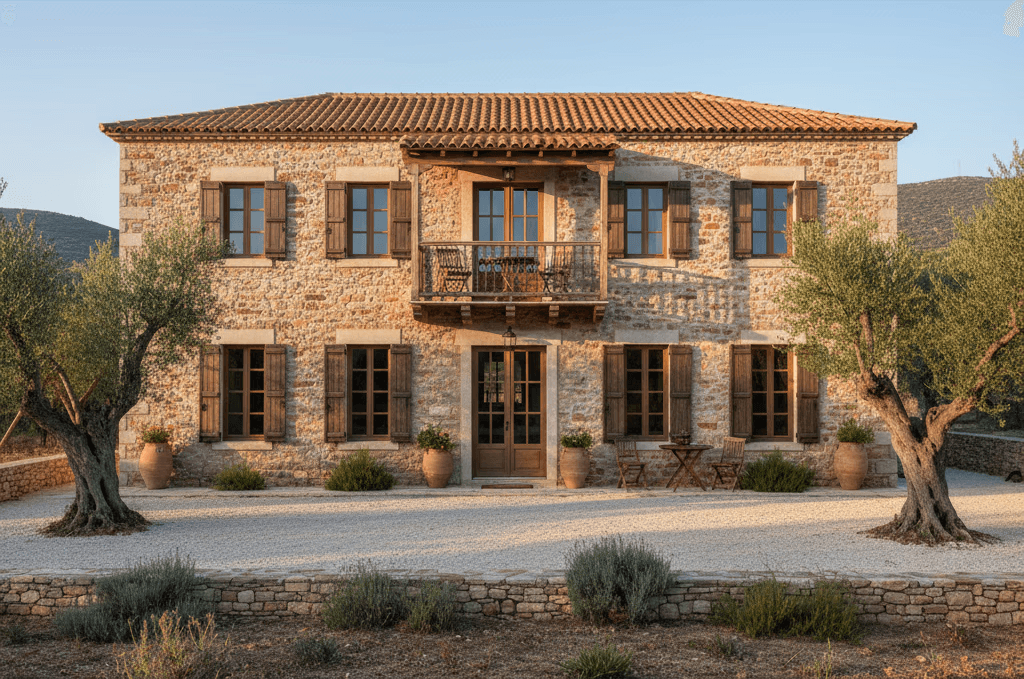
Prioritised findings and photographs.
Local specialist coordination where required.
Legal Due Diligence Does Not Assess the Building.
What a Property Inspection in Greece Covers
Pools, External and Ancillary Areas
Pools, plant spaces, retaining elements, outbuildings, external drainage and site-specific risks where included in the agreed scope.
When to Inspect: Before You Buy, During Construction and at Handover.
Most inspections take place before purchase, but there are three points where an independent check can change the outcome.
Before you buy. Ideally before a preliminary contract or deposit, while the findings can still inform the price, the conditions or the decision to walk away. Whether the purchase can be made conditional on the inspection is a question for your Greek lawyer.
During construction, before walls and floors are closed. For new builds and major renovations, a mid-construction inspection checks the work against the approved drawings while it is still visible: the layout, openings, building services routes, waterproofing, insulation and wet-room build-ups. Once plaster, screed and tiles are in place, many of these items can only be checked by opening up. Structural adequacy remains with the supervising licensed engineer.
At handover. Before you accept the property and release the final payment, the inspection records visible defects, unfinished items and systems that do not work as intended, so they can be raised with the contractor while the contractor is still engaged. The report gives you a written list to hold the handover against.
What We See on Site That Documents Do Not Show.
Drawings, permits and certificates describe what should have been built. On recent inspections in Greece, three things have come up that no document would have revealed.
Contractors do not always follow the approved drawings. This applies even to contractors with a strong local reputation. Changes are made on site for convenience, cost or habit, and for an owner living abroad it is hard to find out until someone compares the work with the drawings in person.
Moisture problems can be complex. Finding the cause of damp or water ingress can take several days of investigation, measurements and tests before it can be narrowed down, and the remedy is often a combination of measures rather than a single repair.
The building permit is not always followed exactly. Deviations from the permit can materially affect the design that was carried out, and in some cases nobody involved had raised it or looked after the owner’s interest.
This is why we attend in person and compare what has been built with what was approved. Where a deviation may have permit or legal consequences, it is recorded and referred to your Greek lawyer and a licensed engineer for formal assessment.
Damp, Mould and Water Ingress: What an Inspection Can Establish.
During a standard inspection, visible damp, staining, mould, salt deposits and signs of water ingress are recorded and photographed. Non-invasive moisture readings are taken at suspect areas and at dry reference points for comparison, and roofs, terraces, wet rooms, external drainage and accessible services are checked for likely sources.
That is often enough to show where a problem is and how far it appears to extend. It is not always enough to show why. Damp in Greek buildings frequently has more than one cause: rising damp, condensation, leaking pipes, failed waterproofing or water entering through the facade, roof or openings. When the readings point in several directions, an extended moisture investigation over several days may be needed, with repeated measurements, monitoring of conditions and tests to rule causes in or out.
The report keeps three things apart: what has been established on site, what needs further investigation and by whom, and what that means for the repair estimate. Where the cause is not yet known, the report says so, so that you do not rely on a cost figure before the problem is understood. The scope and fee for an extended investigation are fixed after a short scoping call.
A Property Survey Report Built for Your Next Decision.
Pre-Purchase Inspections Across Greece.
Property inspections are coordinated across Greece, with licensed local civil engineers and technical specialists involved where the agreed scope requires them.
Property Inspection in Athens: Apartments and Polykatoikia Blocks.
Most Athens purchases are apartments in a polykatoikia, the multi-owner concrete block that makes up much of the city. The unit for sale is only part of what you buy. The roof, facade, lift, common stairs and shared building services sit outside any single owner’s control, yet their condition and any pending common-area works affect every flat in the building. The shared charges, koinochrista, cover common-area upkeep, the lift and, in buildings with a central system, heating. Reviewing the recent charge history before purchase is a sensible step.
Construction era varies block by block, so two apartments on the same street can need very different attention. Closed-in verandas, rooftop rooms and semi-basement conversions are common in older central buildings. We compare the space with the technical file and flag apparent discrepancies; formal planning status and any legalisation route are for your Greek engineer and lawyer.
The inspection covers the unit itself, with a visual review of common areas, the envelope and shared services where accessible. It is not a structural survey of the whole block, but issues affecting the building as a whole are noted because they affect your ongoing costs. For larger renovations in older central buildings, structural, planning or archaeological input may be needed before intrusive works begin.
Property Inspection in Crete: Villas, Farmhouses and Rural Water Supply.
Much of rural and hillside Crete relies on a private borehole, a cistern or a shared village supply rather than a continuous mains connection. That affects how usable the property is and what it costs to run from day one. Where relevant, the inspection records the apparent water source, the storage, pumps and visible pipework, and what still needs to be verified before you rely on the supply, such as yield and water quality.
Building stock on Crete ranges from old stone farmhouses through mixed stone and concrete construction to recent reinforced-concrete villas, and each has a different risk profile. Farmhouses and properties in olive groves often come with outbuildings, retaining walls, drainage on sloping ground, pools and later additions, and each of these extends the scope. Visible cracking, movement and moisture are recorded; where the findings justify it, the report says when a licensed structural engineer should assess the building.
On the coast, salt-laden air, wind and strong sun speed up the deterioration of metalwork, concrete, waterproofing and external finishes, especially where maintenance has been put off. The physical property is compared with the documents provided, and land-use and permit questions are left with your Greek lawyer and engineer. Inspections are arranged across Chania, Rethymno, Heraklion and Lasithi.
Property Inspection in Corfu, Kefalonia and Zakynthos: Venetian Towns and the 1953 Rebuild.
The Ionian islands do not share one building history. In August 1953 a series of earthquakes destroyed most of the buildings on Kefalonia, Zakynthos and Ithaca, and much of what stands there today was built afterwards. On those islands the construction period is a key reference point: it frames which structural questions are relevant and when a licensed structural engineer should follow up.
Corfu took a different path. Corfu Old Town, a UNESCO World Heritage Site since 2007, and many older villages hold stone townhouses and villas from the Venetian, French and British periods. These buildings combine old masonry, timber floors and roofs, and services added over several renovations. Where a property sits in a protected area, what may be altered is for your Greek lawyer or architect to confirm before renovation plans are fixed.
Winters in the Ionian are wet, so roofs, waterproofing, render, masonry and external timber are exposed to sustained damp, and vegetation growing against walls, terraces and drainage is a frequent finding. Materials and specialist contractors are often brought in from the mainland, which can affect remediation cost and timeline. For villas bought for letting, pools, outbuildings and the service history can be included in the scope.
Property Inspection in the Peloponnese: Mani Towers, Stone Ruins and Rural Land.
Many Peloponnese purchases are restoration projects or rural land, and the property type decides the scope. A Mani tower house, a village shell in Messinia or Laconia, an olive estate with outbuildings and a coastal villa in the Argolid are not variations on one risk profile.
Tower houses and older village buildings were built with thick rubble-core stone walls rather than a frame, and many were altered generations ago with new openings, floors or a residential layout. Masonry condition, roof and floor connections, moisture behaviour and the extent of earlier changes are central to understanding what you are buying.
When a stone ruin is bought to rebuild, the question changes. It is less about finishes and more about what structure genuinely remains, and what the restoration architect and structural engineer will need to assess before design and permitting can start. No structural calculations are made; the inspection identifies where that specialist input is needed.
Rural plots and estates are often on agricultural or out-of-plan (εκτός σχεδίου) land, where plot size, road access and forest, agricultural or archaeological designations shape what can exist or be added. We compare the physical property with the documents provided; land-use conclusions stay with your Greek lawyer or engineer. Hillside sites can also bring retaining walls, drainage, water supply and vehicle access to check. Estates with several structures usually call for Technical Due Diligence rather than a single-building inspection.
Property Inspection in Rhodes: Old Town Masonry and Resort-Coast Villas.
Rhodes is two property markets side by side. The Medieval City of Rhodes has been on the UNESCO World Heritage List since 1988 and is protected by the Ministry of Culture, so building work inside the walls runs through archaeological and conservation controls that go well beyond ordinary planning rules. A few kilometres away, the coast around Faliraki, Ixia and Kallithea is largely later reinforced-concrete villas and apartments, many adapted for holiday letting.
In the Old Town, the inspection looks at visible masonry condition, moisture, timber elements, alterations that appear to have changed the historic fabric or original load paths, and services work that looks out of place in a protected building. These are recorded as matters for your Greek adviser to confirm; the inspection does not decide what may be altered.
On the resort coast, the focus moves to waterproofing, concrete condition and visible reinforcement corrosion, render and metalwork exposed to salt air, pool plant, drainage and additions without a clear paper trail. Villas that have carried heavy seasonal occupancy tend to show accelerated wear in exactly these areas.
Rhodes, like the rest of the Aegean, has seismic exposure. Visible cracking patterns, earlier repairs and apparent structural modifications are recorded for a structural engineer to assess; the inspection does not certify seismic capacity.
Mykonos: Villas and Multi-Building Estates.
A Mykonos property is often a principal villa with guest houses, staff accommodation, plant buildings, pools and private water or backup power. That usually calls for a broader scope than a single-house inspection. Inspection and Technical Due Diligence for these assets are covered on our Mykonos page.
Frequently Asked Questions About Property Inspection in Greece.
What is the difference between legal due diligence and a property inspection?
Legal due diligence addresses ownership, title, contracts, encumbrances and the legal transaction. Property Inspection addresses the accessible physical asset, visible condition, building systems and apparent discrepancies that may require follow-up.
How long does a property inspection in Greece take?
Site attendance is usually completed within one working day for a conventional residential property. Larger, multi-building or technically complex assets may require additional time. The written report is typically delivered within five to seven working days after attendance.
Can a property inspection identify unauthorised or undocumented works?
KG Nordic can compare the accessible built condition with the drawings and technical documents provided and identify apparent discrepancies. Formal confirmation of permit status, legalisation or compliance remains with the relevant licensed Greek engineer and legal advisers.
How is the inspection fee determined?
A fixed fee is provided after a short scope discussion and review of the available property information. The fee reflects size, complexity, location, access, documentation and the required depth of review. Travel costs, where applicable, are confirmed in advance.
When is Technical Due Diligence more appropriate than Property Inspection?
Technical Due Diligence is more appropriate where the asset is operational, multi-building, income-producing, intended for redevelopment or requires broader documentation, capital-exposure or specialist review.
Is a property survey required when buying a house in Greece?
No. Greek law does not require the buyer to commission an independent survey or inspection. The seller provides certain documents for the transfer, such as an engineer’s certificate and an energy performance certificate, but these are not a condition report written for the buyer.
Is a Greek property inspection the same as a UK building survey or a US home inspection?
It serves the same purpose: an independent check of condition before you commit. Greece has no direct equivalent of the RICS survey levels, so the scope is agreed for each property and adapted to Greek construction, building services and documents.
When should I book the inspection?
Ideally before you sign a preliminary contract or pay a deposit, while the findings can still inform your decision. Whether the purchase can be made conditional on the inspection is a contract question for your Greek lawyer.
Do I need to be in Greece for the inspection?
No. Many clients are abroad when the inspection takes place. Access is coordinated locally, the report is written in English and the findings are reviewed with you on a call.
Can damp and mould be diagnosed in a single visit?
Visible damp and mould are recorded and measured on site, but the cause is often a combination of sources, such as rising damp, condensation, leaking services or water entering through the building envelope. Narrowing it down can take several days of measurements and tests, and the remedy is often a combination of measures. The report states what was found and what further investigation is needed before you rely on a repair estimate.
Does the inspection cover the whole building, or just the apartment I am buying?
The inspection focuses on the apartment, with a visual review of common areas, the building envelope and shared building services where they are accessible and relevant. It is not a structural survey of the entire block, but apparent issues affecting the whole building are noted, because they can affect your future shared costs.
Is a property close to the sea in Crete a special case?
Yes. The foreshore (aigialos) and beach zone belong to the Greek State, and structures built without a permit inside these zones are, as a rule, excluded from the legalisation scheme for unauthorised constructions. Whether the coastline has been formally delineated, and whether any part of the plot or buildings falls inside these zones, should be confirmed by your Greek lawyer and a licensed surveying engineer before you sign. The inspection records what is built on site; it does not determine the coastal line.
Does a property in Corfu Old Town need a different inspection?
Corfu Old Town has been a UNESCO World Heritage Site since 2007, and its buildings are typically older masonry with timber elements and services added over time. The inspection records visible condition, moisture and apparent alterations. What may be changed under heritage rules is for your Greek lawyer or architect to confirm.
Is a stone ruin inspected differently from a habitable house?
Yes. When a property is bought as a shell to restore, the inspection focuses on what structure remains, the condition of walls and roof, and the starting point for the architect and structural engineer, rather than on finishes and systems. No structural calculations are made; the report states which specialist input is needed before design starts.
Do non-EU buyers need extra approval to buy property in Rhodes?
Usually, yes. Rhodes is in the Dodecanese, which Greek law designates as a border area. Under Law 1892/1990, as amended, buyers whose nationality or company seat is outside the EU and EFTA need the restriction lifted by a committee of the regional Decentralised Administration before the purchase. Whether it applies to your case, and how long it takes, is for your Greek lawyer to confirm. It does not change the technical inspection.
How do I choose the best property inspection firm in Greece?
There is no official ranking of property inspection firms in Greece. Relevant criteria include independence from the transaction, appropriate technical experience, clearly defined scope, direct English reporting, professional boundaries and access to specialist input where required.