Written by Rikard 14 years in construction and owner-side project management €150M+ in governed project value.
Buying Property in Greece - Risk Checklist
Buying property in Greece attracts Northern European investors for clear reasons: climate, relative affordability, lifestyle, and long-term appreciation potential. What is often underestimated is that the technical, legal and construction context differs materially from Northern Europe.
Owners planning to upgrade should also weigh the Greek energy upgrade grants available for primary residences through 2032.
Buyers from outside the EU carry extra documentation and process steps; we cover the specifics for American buyers and for non-EU buyers. For buyers based in Dubai and the GCC, we cover the specifics separately.
The purchase price rarely reflects the true financial exposure. The difference lies in structural practices, regulatory culture, contractor supervision, climate stress, and lifecycle maintenance.
This checklist outlines the main risk categories that materially affect cost, durability and long-term value.
We have consolidated the technical categories below into a downloadable format. Download the 21-point Greece property risk checklist before your next offer.
1. Structural System and Seismic Design
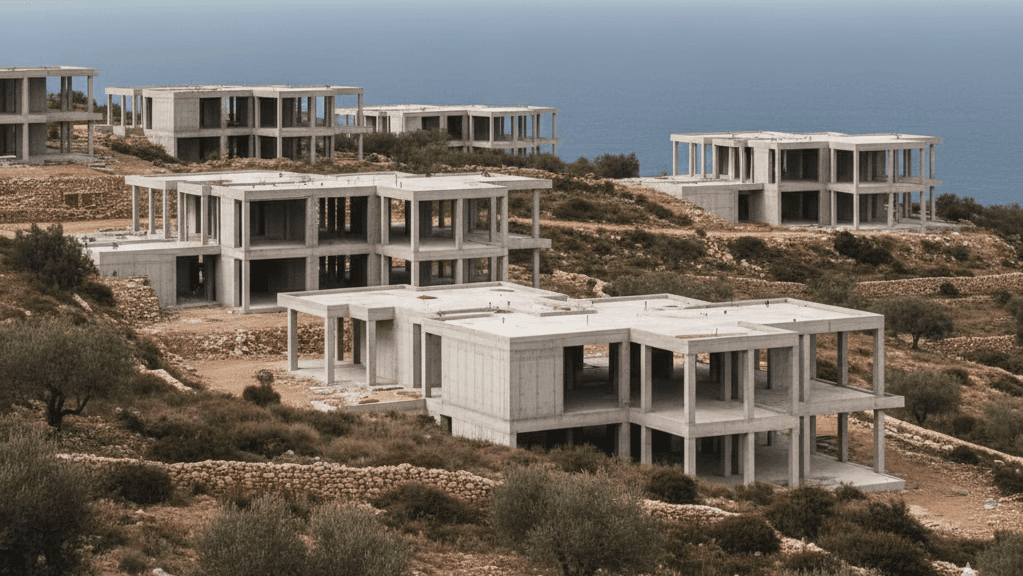
Greece is a high seismic activity region. Most buildings constructed after the 1980s use reinforced concrete frames with infill masonry. While modern seismic codes are advanced, enforcement and quality control vary significantly.
Key risks: Reinforcement detailing inconsistencies, poor concrete curing practices, inadequate vibration during casting, corrosion of rebar in coastal zones, and lack of structural documentation for older buildings.
Pre-1985 buildings often predate modern seismic codes. Even post-2000 properties require verification of actual site execution versus approved drawings.
Technical checkpoint: Review structural study (statics study), verify as-built compliance, inspect for visible cracking patterns (shear cracks vs settlement), and confirm foundation type relative to soil category.
Ignoring seismic classification differences between regions in Greece can result in underestimating structural retrofitting costs. A property condition assessment Greece projects these costs over a ten-year horizon before you commit.
2. Legal Status and Permit Risk
A large percentage of Greek properties contain some form of informal or unauthorized construction.
Typical examples include enclosed balconies, converted semi-outdoor spaces, added storage rooms, pool constructions without updated permits, and expanded square meters beyond approved plans.
Even when “legalized,” documentation must be verified. The burden transfers to the new owner.
Checklist: Obtain full building permit file, compare approved drawings to actual geometry, confirm tax declaration matches actual square meters, verify settlement of legalization penalties, and confirm no outstanding zoning disputes.
Failure here can block resale, financing, or renovation permits.
For a deeper breakdown, read our guide on illegal constructions in Greek property.
3. Roofing and Waterproofing Failures
Flat concrete roofs are common in Mediterranean construction. Membrane waterproofing systems typically have a lifespan of 8–15 years depending on exposure and installation quality.
Common issues: Inadequate slope to drainage points, membrane installed without proper edge detailing, UV degradation, water ponding, and lack of annual inspection.
Water ingress often appears years after purchase and can affect insulation, internal finishes and structural reinforcement.
Budget implication: Full roof membrane replacement runs €60–120 per m² depending on specification. Interior remediation adds 20–40% on top of membrane cost. This is rarely reflected in asking price.
4. Thermal Performance and Condensation
Many properties built before 2010 lack modern insulation standards. Concrete frames with minimal cavity insulation create thermal bridging, surface condensation, mold growth in winter months, and elevated heating costs.
Northern European buyers often underestimate winter humidity combined with intermittent heating.
Technical points: Confirm insulation thickness and continuity, inspect for black spotting behind furniture, verify window glazing specification, and review energy certificate realistically rather than on nominal rating only.
Upgrading envelope insulation post-purchase is structurally complex and expensive.
5. Coastal Corrosion Exposure
Properties within 1–2 km of coastline face accelerated material degradation.
Typical impact areas include reinforced concrete rebar corrosion, metal railings, window hardware, solar water heater frames, and outdoor AC units. Maintenance cycles shorten significantly in saline environments.
Lifecycle impact: External repainting is required every 4–6 years in coastal zones. Steel component replacement runs 30–50% faster than inland. Purchase price does not compensate for this.
6. Mechanical Systems and Utility Infrastructure
Heating systems in Greece often rely on diesel boilers, split-unit air conditioning, and solar water heaters with electric backup.
Common technical risks include aging diesel burners with poor efficiency, improperly sized AC systems, solar panels without freeze protection, and informal plumbing modifications.
Checklist: Inspect boiler age and service history, verify compliance of electrical panel, check water pressure stability, and confirm sewage connection type (municipal vs septic).
Replacing full heating infrastructure can range between €8,000–25,000 depending on property size.
7. Contractor Culture and Supervision Gaps
In Mediterranean construction markets, informal practices are common: verbal agreements, cash transactions, limited written scope definitions, and no structured site supervision. Quality variation is wide.
Without independent oversight, and without a structured technical due diligence process before capital is committed: budget overruns of 15–30% are common, schedule slippage is frequent, and specification downgrades occur silently. The sequence of checks and documents to request is covered in full in our guide to what to check before signing a property contract in Greece.
Northern buyers unfamiliar with local contracting norms often rely excessively on trust-based relationships.
8. Hidden Cost Categories
Beyond purchase price: property transfer tax, notary and registry fees, lawyer representation, topographic survey updates, energy certificate updates, utility reactivation deposits, insurance premiums (higher in seismic zones), and retrofitting to meet personal comfort standards.
A realistic additional 8–15% above purchase price should be budgeted before renovation. If renovation is involved, contingency should not be less than 15%. The full breakdown, item by item with current figures, is in our guide to the hidden costs of buying property in Greece.
BEFORE YOU COMMIT TO A PROPERTY IN GREECE
Send the listing, floor plans, permit documents or agent material before signing anything. We perform preliminary remote acquisition reviews for foreign buyers evaluating properties in Greece.
This early-stage review identifies likely permit inconsistencies, unauthorised modifications, structural exposure indicators, waterproofing and renovation risk, and whether a full on-site inspection is justified before commitment.
The review is independent, English-language and delivered directly to the buyer.
Submit the property details here: kgnordic.com/contact
9. Land and Topography Risk
Hillside and rural plots introduce soil instability, access limitations, septic requirements, water supply uncertainty, and easement disputes.
Verify road legal access, utility rights-of-way, drainage paths, and boundary confirmation via updated topographic survey. Ignoring topography is a recurring source of dispute.
10. Long-Term Ownership Economics
The Mediterranean climate reduces heating cost but increases UV degradation, exterior maintenance frequency, waterproofing cycles, salt-related corrosion, and vegetation overgrowth management.
Ownership economics must consider a 10–20 year lifecycle, not just acquisition. Properties priced attractively often reflect deferred maintenance.
11. Risk Mitigation Framework
Risk reduction is procedural, not emotional.
Effective approach includes: independent property inspection Greece before signing, with inspector selection following the criteria outlined in the guide on how to choose a property inspector in Athens for Attica-based acquisitions including understanding the cost of a building survey in Greece and what the fee should cover, legal documentation cross-check against physical reality, structured renovation budget with contingency, milestone-based contractor payments, on-site supervision during key structural phases, and lifecycle planning covering roof, mechanical systems and exterior envelope.
The purpose of structured technical due diligence is not to eliminate risk. It redistributes it into measurable categories. When risk becomes measurable, pricing becomes rational.
Buyers evaluating vacant pre-1990 properties should also review the Anakainizo renovation programme guide, Greece’s €480M subsidy scheme that changes the financial case for this specific property category.
Buying Property in Greece?
Before contracts are signed, we review structural condition, permit compliance, unauthorised modifications, waterproofing exposure, electrical and plumbing systems and deferred capital expenditure risk. Investors buying from Dubai and the Gulf can see how this supports underwriting in our investment guide.
For foreign buyers unable to assess the asset locally, we provide independent property inspections, remote document reviews and buyer-side technical due diligence across Greece and the Mediterranean. Every report is in English, delivered before you sign.
Submit the asset location and acquisition details here: kgnordic.com/contact
Conclusion
Buying property in Greece is not inherently high-risk. It becomes high-risk when Northern European expectations are applied without adjusting for Mediterranean construction logic.
The primary exposures are legal inconsistencies, structural verification gaps, waterproofing lifecycle, thermal underperformance, informal contracting practices, and underestimated maintenance cycles.
Purchase price is only the entry number. Technical reality determines the true cost.
A systematic risk checklist before acquisition protects capital more effectively than post-purchase correction. Download the 21-point Greece property risk checklist. the same framework used internally by KG Nordic Advisory on every engagement.
Frequently Asked Questions
Q: What are the biggest technical risks of buying property in Greece?
The most consistent technical risks are: unauthorised constructions that transfer liability to the buyer on purchase, permit file discrepancies between the approved drawings and the built structure, deferred maintenance on MEP systems and roofing, and structural issues in older reinforced concrete buildings. None of these are identified through legal due diligence alone.
Q: Does legal due diligence in Greece cover technical risks?
No. Legal due diligence in Greece covers title, encumbrances and ownership history. It does not assess structural condition, permit compliance, MEP systems or capital expenditure. Technical due diligence must be commissioned separately and independently of the legal process.
Q: How do I protect myself when buying property in Greece?
The primary protection is an independent technical review commissioned before contracts are signed. For a straightforward residential acquisition, that may be a Property Inspection. For a complex, operational, multi-unit or investment asset, it may require Technical Due Diligence.
Q: Are property risks in Greece higher for foreign buyers?
The risks are the same as for any buyer, but foreign buyers are more frequently exposed. They typically rely on intermediaries introduced by the seller, lack local context to identify what is not being disclosed and are less likely to commission independent technical review. These factors combine to increase the probability of undisclosed exposure transferring to the buyer.